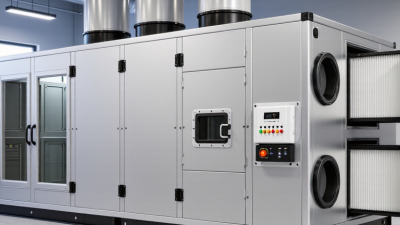
So you're in the market for an air handling unit, huh? It's not just about making sure the airflow matches the room size – there's way more to it. The thing is, the unit has to actually fit the building, its day-to-day schedule, and what people in that space really feel. If you size it for peak load, it might run like a clunky old car during off-peak hours, wasting energy. And if you just go for the cheapest option upfront, you might end up paying for it later with higher energy bills or a maintenance headache that just won't quit.
Okay, first things first—you need to nail down your airflow, heating and cooling loads, and outdoor-air requirements. Once you've got those, check the installation space, electrical supply, and duct hookups. Yeah, these steps sound super basic, but you'd be surprised how often people skip them. Also, don't just look at the fan's headline airflow rating; see how it actually performs at the expected system pressure. And when you're comparing units, take a close look at Filter stages, coil access, controls, noise levels, and whether heat recovery is worth it. So, here's something to ask about: how are they going to replace the filters and clean out the components? Because if that service panel is cramped, a simple routine task becomes a recurring nightmare – trust me, you don't want that.
If you're working on an industrial Air Purification project, it's worth taking a step back to define exactly what contaminants you're dealing with and what filtration targets you need—before you start comparing equipment. Here's the thing: just because a filter works fine for general ventilation doesn't mean it'll automatically handle your specific process or indoor air concern. So talk it over with qualified design professionals about your intended application, and don't be shy about asking for documented performance data for the exact configuration they're proposing. Look, you want to make sure the numbers actually match the conditions you’ll be running in. Brochures? They’re great for pretty pictures, but they hardly ever lay out every trade-off. Choosing the right system means juggling performance, serviceability, lifecycle cost, and a bit of future-proofing. And even then, things change once it’s installed—your assumptions might not hold. So leave some breathing room, check the real airflow and comfort levels, and don’t treat the spec sheet like gospel.
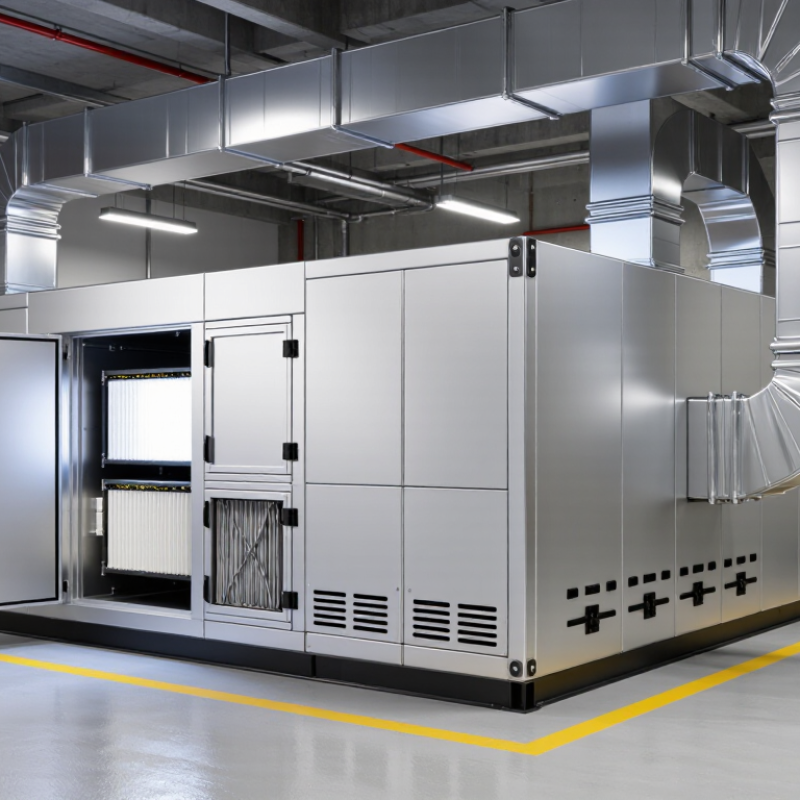
Define the Design Load and Airflow: Qₛ = 1.08 × CFM × ΔT (°F)
Choosing an air handling unit starts with the room’s design load, not the largest unit available. For sensible cooling, use Qₛ = 1.08 × CFM × ΔT (°F), where Qₛ is heat removed in Btu/h, CFM is airflow, and ΔT is the temperature difference between return and supply air. The factor 1.08 assumes typical air density and standard conditions. For example, 1,000 CFM with a 20°F temperature difference removes about 21,600 Btu/h of sensible heat. That is a useful estimate, not a complete system design.
Measure or calculate the actual room load before setting airflow. Solar gain through a west-facing window, warm equipment, and crowded rooms can shift the result. A unit sized from sensible heat alone may also miss humidity control needs; latent load requires separate consideration. Check the manufacturer’s fan data at the required airflow and external static pressure, since filters and duct resistance affect delivered CFM. A Kitchen Air Cleaner may capture cooking particles, but it does not replace properly designed ventilation or load calculations.
Tips: Confirm the design temperatures and airflow assumptions with a qualified HVAC professional. Keep a little skepticism: field conditions rarely match every calculation, and a neat number can hide a poor assumption. Monitor room temperature and humidity after startup, then adjust where measurements support it.
Determine Outdoor-Air Requirements Using ASHRAE 62.1
When choosing an air handling unit, calculate outdoor air from actual room use, not floor area alone. ASHRAE Standard 62.1-2022, Table 6-1, lists office ventilation rates of 5 cfm per person plus 0.06 cfm per square foot.
For a 1,000-square-foot office with 10 occupants, that gives 110 cfm in the breathing zone before system adjustments. Check the applicable occupancy category and locally adopted edition; conference rooms can require different rates.
ASHRAE’s Ventilation Rate Procedure also accounts for zone air distribution effectiveness and system ventilation efficiency. These factors affect the outdoor-air intake an AHU must deliver. For example, a ceiling supply layout may distribute air differently from low-level delivery. Confirm diffuser locations, occupancy schedules, and return-air paths before sizing dampers and fans. The headcount on a drawing can be optimistic.
That estimate can still miss real use. A room may hold more people during events, while a lightly occupied space may need demand-control ventilation. Verify sensor placement and control sequences during commissioning. Exhaust Air Cleaning may help manage specific exhaust contaminants, but it does not replace required outdoor air. Keep calculation assumptions and test results with the design record; they make later adjustments easier to assess.
Match Fan Airflow to Required External Static Pressure
Choose an air handling unit fan at the design airflow and the required external static pressure, not at its maximum airflow rating. External resistance comes from the ductwork, dampers, grilles, and other components outside the unit. Confirm which losses the stated pressure includes; filters and coils may be inside the unit boundary. Small details matter. A loaded filter can raise resistance, so check the specified operating condition and the unit’s pressure definitions before comparing fan curves.
The U.S. Department of Energy’s Improving Fan System Performance sourcebook outlines the fan affinity laws: at similar operating conditions, airflow changes with fan speed, pressure with speed squared, and power with speed cubed. A 10% speed increase can therefore raise pressure by about 21% and power by about 33%. That trade-off is easy to overlook. Use the fan curve to find a stable operating point at the required airflow and pressure, then verify motor capacity and control range. AMCA Publication 201, Fans and Systems, also discusses how installation effects can alter actual fan performance. Tight elbows or abrupt transitions near the inlet may undermine a tidy selection calculation. Real duct layouts are rarely perfect; document assumptions and allow the design team to review them.
Choose Filters by MERV Rating and Account for Pressure Drop
How to Choose an Air Handling Unit? Choose Filters by MERV Rating and Account for Pressure Drop
A filter’s MERV rating describes particle-removal efficiency, not the full cost to your air-handling unit. Under ANSI/ASHRAE Standard 52.2, MERV 13 filters capture at least 50% of particles measuring 0.3–1 micrometer, 85% at 1–3 micrometers, and 90% at 3–10 micrometers. These test ranges help match filtration to indoor-air goals. They do not guarantee identical performance in every system. That distinction matters.
Check pressure drop at the unit’s actual airflow. ASHRAE 52.2 reports a filter’s resistance to airflow under defined test conditions, but your fan must also handle the filter’s loading over time. Compare the manufacturer’s clean-filter resistance with its recommended final resistance, then confirm the fan has enough available static pressure. A higher-Merv Filter can increase resistance and reduce airflow if the system was not designed for it. Not a small detail.
For example, when reviewing an AHU scheduled for 10,000 cubic feet per minute, compare candidate filters at that airflow—not just by rating or face size. Confirm the pressure-drop figures use comparable test conditions, and verify airflow after installation. A commissioning check can catch a mismatch that paperwork misses. I’d still revisit assumptions: actual dust loading and maintenance intervals can differ from estimates. Source: ANSI/ASHRAE Standard 52.2, Method of Testing General Ventilation Air-Cleaning Devices for Removal Efficiency by Particle Size.
How to Choose an Air Handling Unit? - Choose Filters by MERV Rating and Account for Pressure Drop
Compare filtration needs with the air handling unit’s available fan pressure. Pressure-drop figures below are illustrative clean-filter ranges at approximately 2.0 m/s (400 fpm) face velocity; actual values vary by filter design, size, and airflow. Confirm selections against the filter manufacturer’s performance data and the system design.
| MERV rating | Minimum particle-size efficiency category* | Typical application | Illustrative clean-filter pressure drop | Selection and AHU check |
| MERV 8 | At least 70% in the 3.0–10.0 μm size range | General residential and light-commercial prefiltration | 40–90 Pa (0.16–0.36 in. w.g.) | A lower-resistance option for basic particle control; check that the filter rack seals correctly to prevent bypass. |
| MERV 11 | At least 65% in the 1.0–3.0 μm size range | Enhanced filtration for offices and other occupied buildings | 60–130 Pa (0.24–0.52 in. w.g.) | Compare the filter’s rated airflow and pressure drop with the AHU fan curve and required design airflow. |
| MERV 13 | At least 50% in the 0.3–1.0 μm size range | Higher-efficiency filtration where finer particles are a concern | 75–160 Pa (0.30–0.64 in. w.g.) | Allow for filter resistance at the design airflow; verify fan capacity and acceptable airflow at the filter’s final resistance. |
| MERV 14 | At least 75% in the 0.3–1.0 μm size range | Applications requiring higher particle removal and a compatible system design | 100–200 Pa (0.40–0.80 in. w.g.) | Check the fan’s available static pressure, motor loading, filter dimensions, and replacement access. |
| MERV 15–16 | MERV 15: at least 85%; MERV 16: at least 95% in the 0.3–1.0 μm size range | Specialized high-efficiency applications; confirm suitability for the intended system | 120–250 Pa (0.48–1.00 in. w.g.) | Use product-specific pressure-drop data and assess the complete system; these ratings do not by themselves establish HEPA performance. |
Design note: Filter pressure drop rises as dust accumulates. Size the fan and determine the filter-change point using the specified airflow, clean and final filter resistance, and pressure losses from all other system components. *Efficiency categories are based on ASHRAE Standard 52.2; confirm the applicable test data and rating for the selected filter.
Size Heating and Cooling Coils at Design Entering-Air Conditions
When choosing an air handling unit, size its heating and cooling coils using the air conditions the coils will actually receive at design load. For cooling, confirm entering dry-bulb temperature and humidity, not just the room setpoint. A coil handling 30°C air at high humidity faces a different load from one handling cooler, drier air. Check airflow, leaving-air targets, and both sensible and total capacity. Small changes matter.
For heating, use the winter design entering-air temperature and the required leaving-air temperature. Then verify available hot-water or steam conditions, coil rows, and air-side pressure drop. Ask the supplier to state the assumptions behind each selection. A capacity figure without entering-air data is hard to compare. Keep the duct layout and fan allowance in view, too; a dense coil can add resistance. If the unit includes Exhaust Air Filtration, account for its pressure drop and its effect on exhaust airflow separately. Field conditions may differ from the design point. They often do. Recheck selections when ventilation rates, altitude, or glycol concentration change, and document any unresolved assumptions before equipment is ordered.
Compare AHRI 430-Rated Airflow, Pressure, and Performance
An air handling unit should be compared at the duty point your building actually needs, not by its maximum airflow alone. AHRI Standard 430 provides a common basis for rating central-station units, including airflow and external static pressure. Check both values together: a unit delivering 10,000 cubic feet per minute at 1.0 inch water gauge may not meet the same requirement at 2.0 inches. Duct resistance, filters, coils, and dampers all add pressure. Small details matter.
Compare fan input power at the same airflow and pressure, then review coil capacity and operating conditions. The U.S. Energy Information Administration’s 2018 Commercial Buildings Energy Consumption Survey reports that space heating, cooling, and ventilation together account for roughly half of commercial building site energy use. Efficient selection has real operating consequences. Ask for certified ratings or test documentation, and confirm the proposed configuration matches the scheduled filters and coils. A catalogue figure can look convincing. It may not describe your installed unit.
Consider the actual space, too. A Restaurant Air Cleaner can address local airborne particles, but it does not replace adequate ventilation or correct a poorly selected air handler. Check sound levels near occupied areas and leave access for filter changes. Ratings simplify comparisons, but field conditions can still differ. That deserves a second look.
Check Cabinet Fit, Service Access, Controls, and Sound Data
How to Choose an Air Handling Unit?
An air handling unit can fit on paper and still fail in the plant room. Measure doorways, lift routes, ceiling height, and the final footprint before selecting a cabinet. Leave room to remove filters and coils, open access panels, and pull fan assemblies. Check the service side, not just the overall dimensions. A few centimeters can matter.
Ask for the unit’s control sequence and points list. Confirm that sensors, actuators, alarms, and building controls can communicate as required. Review what happens during startup, shutdown, freeze protection, and filter alarms. “Controls included” is too vague. Get the details in writing. Also check that access panels will not block nearby pipework or cable trays. Drawings can miss this.
Sound needs more than one number. Request sound data at the proposed airflow and external static pressure, and check both inlet and discharge values. Octave-band data helps identify low-frequency fan rumble that a single decibel figure may hide. Compare the figures with the room’s acoustic limits and duct layout. Ask how the data was measured. Site noise assumptions are often optimistic. If the operating point changes, request revised sound data before ordering.
How to Choose an Air Handling Unit? — Check Cabinet Fit, Service Access, Controls, and Sound Data
Illustrative sound data: The chart shows example sound power levels by octave band, in dB re 1 pW. For a real selection, compare certified manufacturer data with the project’s acoustic limits. Also confirm the cabinet fits the available route and plant space, allow room to remove filters and coils, and check that the controls support the required sensors, signals, and building-management-system interface.
Conclusion
Choosing an air handling unit begins with a clear understanding of the building’s design load and required airflow. Estimate sensible cooling capacity using Qₛ = 1.08 × CFM × ΔT (°F), then determine outdoor-air needs in accordance with ASHRAE 62.1. Select a fan that can deliver the required airflow against the system’s external static pressure, and choose filters by MERV rating while allowing for their pressure drop.
Next, size heating and cooling coils using the design entering-air conditions, and compare airflow, pressure, and performance data rated to AHRI 430. Before finalizing the selection, confirm that the cabinet fits the available space and allows practical access for inspection and service. Review control requirements and sound data as well, so the chosen unit meets operational needs while supporting reliable performance and occupant comfort.

 Online Message
 Phone:+8613927702137
 E-Mail: kleanesp@kleanland.com
 Whatsapp: +8613927702137