Phone:+8613927702137

You know, indoor air quality isn’t just about making a space look nice anymore — it’s a real priority when shopping for stuff. According to the World Health Organization’s 2022 Air Quality Database, nearly 99% of us are breathing air that's worse than what's recommended for fine particles. And here’s the tricky part: particles, odors, and biological contaminants all need different solutions. That’s why choosing the right UV Air Filter really isn’t something you should rush into without doing your homework.
This guide takes a deep dive into ten different types of UV air filters for folks around the world. We’re talking everything from in-duct UV-C systems and portable units to HVAC coil lamps, ceiling-mounted cleaners, and even those designed specifically for restaurants. The new ASHRAE Standard 241-2023 introduces something called 'equivalent clean airflow,' which is actually a pretty handy way to compare how well different systems clean the air. And the EPA has a good point too — air cleaners should complement your existing filtration and ventilation, not replace them entirely. For example, a restaurant air filter might have to handle grease, smoke, heat, and long hours of operation. Just relying on lab claims? Not enough — you gotta look deeper.
Keep in mind, performance isn’t just about the wattage or fancy specs; it also depends on the right dose of UV, how much air is moving through, the age of the lamps, proper shielding, regular maintenance, and correct installation. Tiny details catch a lot of us off guard. A dusty lamp, for example, won’t work as well, and poorly designed equipment could even accidentally release ozone you don’t want breathing in. William P. Bahnfleth, a respected expert from ASHRAE, reminds us that 'no single measure is going to be totally effective.' It’s a warning worth heeding. Sometimes, folks compare UV lights just by wattage, which isn’t a great idea — it’s an imperfect shortcut.
So, what should you really focus on? Checking if the product design matches credible testing, seeing if there's easy access for service, considering your local voltage, and understanding real-world operating conditions. Always question those flashy promises and ask for independent proof — because the truth is, the best UV air filter isn’t necessarily the one with the highest wattage or most power, but the one that performs reliably in your specific situation.
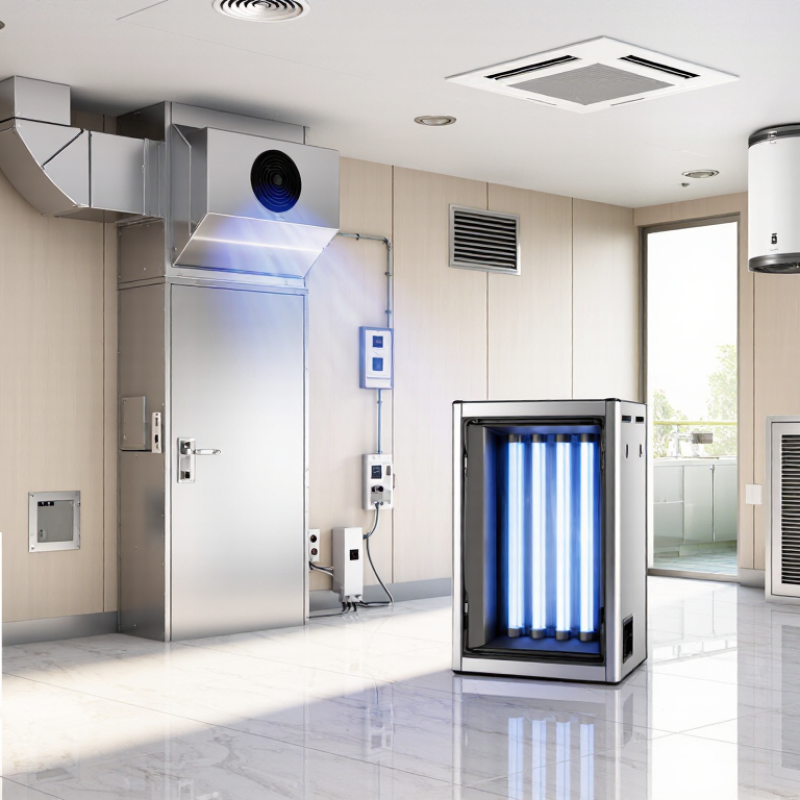
A UV Air Filter is not a simple screen that catches visible dust. It uses ultraviolet-C (UV-C) energy inside an enclosed air-cleaning unit. When contaminated air passes near the lamp, UV-C disrupts the genetic material of many microorganisms. This can reduce their ability to reproduce. The result depends on dose, airflow speed, lamp output, and exposure time. Short contact is not enough.
Common designs include in-duct systems, portable room units, ceiling modules, and UV-C chambers paired with mechanical filtration. In practice, a combined Air Filter works better for occupied rooms. A pleated prefilter traps lint and dust, while UV-C treats air moving across its surface. Imagine a return-air grille collecting pet hair before the air reaches the lamp. Cleaner surfaces help maintain useful ultraviolet exposure. UV-C does not remove smoke, allergens, or chemical vapors by itself.
Reliable installation requires shielding, correct electrical design, and regular inspection. Direct UV-C exposure can injure eyes and skin, so the lamp should remain inaccessible during normal use. Technicians should check airflow, lamp aging, and surface buildup rather than trusting a glowing bulb. Some systems need lamp replacement even when the lamp still looks bright. A limitation deserves honesty: performance claims from small test chambers may not match a busy classroom or kitchen. Real rooms have open doors, uneven airflow, and changing pollution loads. That gap is easy to underestimate.
UV air filtration systems use ultraviolet energy to reduce airborne microorganisms inside ducts, air handlers, and room units. The most established technology is UV-C, often produced near 254 nanometres by low-pressure lamps. Newer UV-C LEDs can operate around 265–280 nanometres. Their performance depends on intensity, exposure time, airflow, and surface distance. A fast-moving air stream may receive too little dose, even when the lamp looks bright.
Several system types serve different buildings. In-duct UV units sit beside cooling coils and reduce microbial growth on wet surfaces. Upper-room systems direct UV-C above occupied areas, where air mixes slowly. Fan-coil modules treat recirculated air near the blower. Photocatalytic oxidation combines UV light with a catalyst to break down selected pollutants, but results vary with humidity and contact time. Buyers searching for an “Ozone Air Filter” should check the technology carefully. Ozone generation is not the same as UV-C filtration and requires strict safety evaluation.
Reliable selection requires measured data, not attractive lamp ratings. Ask for irradiance, delivered dose, airflow range, test methods, and replacement intervals. Keep lamps clean; dust can form a thin brown film and reduce output. Filters still matter because particles can shield microorganisms from UV exposure. A common mistake is judging effectiveness by room size alone. I have seen undersized systems installed in long ducts with poor lamp placement. They illuminated the air, but not for long enough. Maintenance access also deserves attention, since a difficult service panel can turn a sound design into a neglected one.
Ten UV air filter types serve homes and commercial buildings. Central-duct UV-C units treat air inside main ductwork. Return-air systems operate near the intake grille. Supply-air units sit after the blower. Coil-mounted lamps target wet evaporator coils, while air-handler systems protect internal compartments. Furnace-integrated models combine UV-C with a Furnace Air Filter. Portable UV air cleaners serve bedrooms and small offices. Ceiling-cassette units fit suspended ceilings. Fan-coil systems suit hotels and clinics. Packaged rooftop units protect larger commercial zones.
ASHRAE’s HVAC Applications Handbook identifies approximately 253.7 nanometers as a highly effective UV-C wavelength. It also stresses exposure dose, airflow, and contact time.
The U.S. Environmental Protection Agency explains that UV devices should not replace particle filtration or ventilation. A MERV-rated filter still captures dust and many airborne particles. UV-C mainly supports microbial control on surfaces and within moving air. A lamp can glow brightly and still underperform. That detail matters.
Buyers should check irradiance, lamp life, shielding, access panels, and maintenance records. Coil-mounted systems may reduce buildup around damp surfaces, but poor cleaning can weaken results. Energy use also varies with fan operation and lamp count. Real buildings are messy; doors open, filters clog, and airflow changes. Therefore, product selection should follow an engineer’s airflow survey, local safety requirements, and the equipment manufacturer’s service instructions.
UV air systems are not interchangeable, even when their lamps look similar. The key differences are UV dose, airflow tolerance, service life, and installation position. Low-pressure mercury lamps deliver efficient UV-C at a narrow wavelength. Amalgam lamps maintain stronger output across wider temperature ranges. Medium-pressure lamps cover broader wavelengths and suit high-throughput treatment, but they consume more power. UV-C LED arrays start instantly and allow compact, zoned designs. Output can fall sharply with heat.
In-duct UV-C modules treat moving air inside supply or return ducts. Coil-irradiation systems focus on damp cooling coils and drain pans, where shadows and dust reduce exposure. Upper-room UVGI places fixtures above occupied zones, using room mixing rather than direct airflow. Portable units serve bedrooms, clinics, or temporary spaces, but coverage depends on fan speed and placement. These four arrangements can use similar lamps, yet their performance is not comparable. Location changes everything.
HEPA-plus-UV units combine particle capture with microbial inactivation; UV alone does not remove dust. Photocatalytic UV systems add a coated surface and may address selected volatile compounds. Results depend on catalyst condition and contact time. Testing should measure delivered dose, not lamp wattage. Filters, reflectors, sensors, and interlocks need regular inspection. Field data can disappoint. Air leakage, dirty sleeves, and uneven velocity often undermine laboratory ratings. A cautious buyer checks independent test methods, replacement access, and ozone claims before comparing prices.
Comparison of common UV air-treatment technologies and installation formats for commercial, industrial, healthcare, and residential applications.
| No. | UV Air Filter Type | Typical UV Range or Source | Primary Air-Treatment Mechanism | Relative Microbial Performance | Airflow and Contact-Time Characteristics | Typical Applications | Main Advantages | Key Limitations and Buyer Considerations |
|---|---|---|---|---|---|---|---|---|
| 1 | Low-Pressure Mercury UVC Lamp | Predominantly 253.7 nm UVC | Direct photoinactivation of microbial DNA or RNA when the delivered UV dose is sufficient. | High for many bacteria and viruses Effectiveness varies by organism, dose, humidity, and lamp age. | Works well in ducts, air-handling units, and enclosed chambers. Requires adequate irradiance and exposure time; high air velocity can reduce dose. | HVAC systems, in-duct air disinfection, return-air systems, and enclosed air-cleaning equipment. | Mature technology, widely documented, good electrical efficiency, and generally predictable output. | Mercury-containing lamps require proper end-of-life handling. Output declines with operating hours, and direct exposure must be prevented. |
| 2 | Amalgam UVC Lamp | Primarily around 253.7 nm, using an amalgam lamp design | Direct UVC photoinactivation with a high-output lamp that maintains performance over a broader temperature range. | High at suitable dose Often selected where higher UV intensity is required in a compact installation. | Suitable for larger air-handling units and systems with demanding airflow rates. Requires engineered lamp spacing and dose distribution. | Large commercial HVAC systems, industrial air handlers, and high-output disinfection chambers. | High output per lamp, relatively stable operation across temperature changes, and reduced lamp count in some designs. | Higher initial cost and electrical demand than basic lamp systems may apply. Mercury management and shielding remain necessary. |
| 3 | Medium-Pressure Mercury UVC Lamp | Broad UV spectrum, commonly covering UVC and UVB with some visible and UVA output | Broad-spectrum photochemical inactivation; some systems also use the output for advanced oxidation processes. | High potential at high dose Performance depends strongly on spectral output, chamber design, and exposure time. | Useful in compact, high-intensity reactors and specialized treatment chambers. Typically operates at higher power and temperature. | Industrial air-treatment systems, specialized process-air equipment, and applications requiring high instantaneous intensity. | High radiant intensity and compact reactor potential. | Higher energy use, heat generation, and maintenance complexity. Ozone formation must be assessed when wavelengths below approximately 240 nm are present. |
| 4 | UVC LED Air-Cleaning Module | Usually selected in the germicidal UVC region, commonly about 265–280 nm | Direct photoinactivation using semiconductor UVC emitters. | Medium to high, design-dependent Current performance depends on LED optical power, thermal management, and dose uniformity. | Best suited to compact, short-path air channels or modular systems. Airflow must be controlled to provide adequate dose. | Portable units, vehicle ventilation, compact HVAC modules, appliances, and equipment with frequent switching. | Instant start, mercury-free construction, compact size, flexible control, and easier integration into small equipment. | Higher cost per delivered UVC watt can apply. Heat dissipation, optical aging, and low irradiance in poorly designed chambers are important concerns. |
| 5 | Far-UVC Excimer Module | Commonly centered near 222 nm, depending on the excimer source and optical filtering | Short-wavelength UV photoinactivation, with research focused on reducing penetration into living tissue compared with conventional UVC. | Promising for airborne microbes Real-world performance and safety depend on dose, filtering, exposure limits, and applicable regulations. | Can support occupied-space or upper-air concepts only when the complete system meets applicable photobiological safety requirements. | Research, specialized occupied-space studies, and carefully controlled upper-air or air-treatment installations. | Potential for continuous operation in selected occupied environments when properly engineered and approved. | Technology and regulations are still developing. Ozone, unwanted wavelengths, material compatibility, and exposure limits must be independently verified. |
| 6 | UV-A Photocatalytic Oxidation (PCO) Filter | Typically UV-A around 365–405 nm combined with a photocatalyst such as titanium dioxide | Photocatalytic reactions can oxidize selected organic contaminants and may contribute to microbial control. | Variable Not equivalent to direct UVC disinfection; results depend on catalyst condition, airflow, humidity, and contaminant concentration. | Requires catalyst surface contact and sufficient residence time. Pressure drop is usually determined by the catalyst carrier and prefilter design. | Odor and selected VOC-control applications, laboratories, commercial buildings, and combined air-cleaning systems. | Can address some gaseous contaminants in addition to particulate filtration when properly designed. | May generate intermediate oxidation products if poorly engineered. Requires emissions testing; it should not be specified solely as a replacement for particle filtration or UVC disinfection. |
| 7 | In-Duct UVGI Air Treatment | Usually low-pressure UVC or UVC LED sources installed inside ductwork | UV germicidal irradiation treats microorganisms suspended in moving air. | Medium to high Depends on airflow, duct dimensions, lamp placement, reflectivity, humidity, and calculated UV dose. | Designed for continuous air movement. Longer irradiation sections, lower velocity, and multiple lamp banks generally improve delivered dose. | Central HVAC systems, return-air ducts, supply-air sections, and commercial or industrial buildings. | Uses existing air-distribution infrastructure and can treat large air volumes without adding substantial particle pressure drop. | Does not remove dust or allergens by itself. Lamp access, interlocks, shielding, airflow measurement, and HVAC compatibility are essential. |
| 8 | Upper-Room UVGI System | Usually shielded 253.7 nm UVC fixtures installed above the occupied zone | Disinfects airborne microorganisms that circulate into the upper-room UV field through natural or mechanical mixing. | Medium to high in suitable rooms Strongly influenced by room mixing, fixture distribution, ceiling height, and correct shielding. | Relies on room air movement rather than a narrow duct residence time. Ceiling fans or mechanical ventilation can improve mixing when properly designed. | Healthcare facilities, classrooms, waiting areas, shelters, and other occupied spaces with high airborne-transmission concerns. | Can continuously treat room air while people are present when designed and maintained according to safety requirements. | Requires strict control of direct eye and skin exposure, careful layout, cleaning, commissioning, and periodic UV output checks. |
| 9 | Fan-Filter UV Air Cleaner | UVC lamp or UVC LED module integrated with a fan and, in many designs, a particulate filter | Moves air through a controlled chamber for UV exposure; the filter captures particles while UV treats exposed air and surfaces. | Medium to high Depends on clean-air delivery rate, filter efficiency, UV dose, and chamber bypass control. | Performance is commonly evaluated by airflow rate and clean-air delivery. Excessive fan speed can reduce UV contact time. | Portable room units, classrooms, offices, bedrooms, clinics, and temporary or supplemental air cleaning. | Easy deployment, measurable airflow, and the possibility of combining particle removal with microbial inactivation. | Noise, energy use, filter replacement, fan bypass, and actual UV dose should be checked. A UV lamp does not substitute for an appropriately rated particle filter. |
| 10 | HVAC Coil and Drain-Pan UV Treatment | Usually low-pressure UVC lamps installed near cooling coils and drain pans | Continuous irradiation helps suppress microbial growth on moist HVAC surfaces and may reduce surface-associated contamination. | High for surface control It is not primarily a stand-alone airborne disinfection method unless the design also provides sufficient air-path dose. | Operates continuously across coil surfaces. Airborne performance is limited when air passes rapidly without sufficient irradiance and exposure time. | Air-handling units, cooling coils, drain pans, hospitals, offices, hotels, and humid commercial HVAC environments. | Helps control biofilm and microbial buildup, supports coil cleanliness, and may help maintain heat-transfer performance. | Must be sized for complete surface coverage. Reflective materials, lamp cleaning, access safety, condensate compatibility, and material degradation require review. |
Global buyers comparing the top 10 types of UV air filters should begin with application data, not appearance. UV-C modules, combined HEPA-UV units, duct-mounted systems, and portable purifiers perform differently.
Airflow rate, room volume, exposure time, and lamp output determine real disinfection performance. A higher wattage does not automatically mean better results.
In my experience, purchasers often overlook pressure drop and maintenance access. Check the clean-air delivery rate, fan noise, power consumption, and replacement intervals.
Ask for independent test reports showing measured UV dose under realistic airflow. Safety matters too. Look for shielding, door interlocks, electrical protection, and clear instructions.
Ozone generation should be assessed according to the lamp design and local requirements. Certification rules differ between markets, so verify documents with recognized testing bodies before ordering.
Marketing claims can sound precise but remain incomplete.
Tips:
Request performance data at your intended airflow. Confirm spare lamp availability and total ownership cost.
Inspect how dust reaches the UV chamber. A dirty sleeve reduces output. Choose controls that prevent accidental exposure.
Do not assume every unit suits hospitals, offices, or homes. The cheapest option may create frequent service problems.
No checklist is perfect. Recheck assumptions after installation, because actual airflow may differ from the design.
Global buyers should judge UV air filters by safety and verified performance, not lamp count. Common types include in-duct UV-C units, coil-treatment systems, portable purifiers, and upper-room fixtures. UV-C can damage eyes and skin when shielding fails. ASHRAE Standard 241 recommends evaluating equivalent clean airflow, because UV performance depends on dose, airflow, humidity, and contact time. A glowing lamp proves little.
Certification should cover electrical safety, electromagnetic compatibility, photobiological risk, and measured UV output. Request independent test reports, installation drawings, and replacement instructions. The U.S. Environmental Protection Agency notes that filtration performance depends on particle size and airflow. Therefore, pair UV treatment with a properly sized mechanical filter. A Carbon Air Filter may reduce odors, but it does not replace particulate filtration or pathogen control. Some products make broad claims without showing laboratory conditions. That gap deserves attention.
Tips: Keep UV lamps shielded and interlocked. Confirm duct dimensions before purchase. Install service labels near access panels. Replace lamps according to measured output, not appearance; lamps can look bright while producing weaker UV-C. Clean dust from coils and reflectors during scheduled maintenance. CDC guidance on ventilation and air cleaning stresses correct placement and regular operation. Maintenance records should include lamp hours, filter pressure, inspection dates, and technician qualifications. Small omissions matter. Even certified equipment can underperform after poor installation.
Stenter machines are essential for controlling fabric width, dimensional stability, and finish, but they also consume substantial thermal energy and discharge hot, particle-laden air. A gas air filter combined with a stenter waste heat recovery system can improve process efficiency by removing lint, oil mist, and suspended contaminants before exhaust air reaches the heat exchanger. The recovered heat can then preheat incoming combustion air or fresh process air, reducing the fuel required to maintain operating temperatures.
The opportunity is significant in the context of global textile growth. The Textile Exchange *Materials Market Report 2023* recorded approximately 116 million tonnes of global fiber production in 2022 and projects continued expansion toward 2030, increasing pressure on manufacturers to reduce energy and emissions per unit of fabric. The International Energy Agency (IEA) identifies industry as responsible for roughly one-quarter of global energy-related greenhouse-gas emissions, highlighting the importance of practical efficiency measures in heat-intensive production. For dyeing and finishing plants, recovering exhaust heat directly addresses one of the largest avoidable losses in continuous thermal processing.
A well-designed system should include temperature monitoring, airflow control, accessible filter maintenance, and corrosion-resistant heat-transfer components. Effective filtration protects the recovery unit from fouling, while automated bypass control helps maintain stable stenter conditions during start-up or changes in fabric style. By recycling otherwise wasted thermal energy, the system can lower fuel consumption, reduce exhaust temperatures, and support measurable progress toward the energy and carbon-reduction priorities outlined in IEA and Textile Exchange reporting.
It uses ultraviolet energy to reduce airborne microorganisms inside ducts, air handlers, or room units. It does not replace ordinary filters.
Traditional low-pressure lamps often operate near 254 nanometres. Newer UV-C LEDs commonly operate around 265–280 nanometres.
No. Performance depends on intensity, exposure time, airflow, and distance. Fast air may receive too little UV dose.
In-duct units treat air and wet coils. Upper-room systems treat air above occupied spaces. Fan-coil modules treat recirculated air.
Ask for irradiance, delivered dose, airflow range, test methods, power use, and replacement intervals. Independent test data is useful.
Particles can shield microorganisms from UV exposure. A filter also captures dust that would otherwise reach the UV chamber.
Keep lamps and protective sleeves clean. Dust can create a thin brown film and reduce output. Make service access easy.
Look for shielding, door interlocks, electrical protection, and clear instructions. Some designs may produce ozone, so check local requirements carefully.
No. Airflow, exposure time, lamp placement, and room volume also matter. A long duct can receive light without receiving enough dose.
Choosing the cheapest unit may create frequent service problems. I would recheck assumptions after installation, because actual airflow may differ.
UV air filters use ultraviolet light to help reduce airborne microorganisms and improve indoor air quality when integrated with suitable air-cleaning equipment. A Uv Air Filter may combine UV-C lamps, UV-LED modules, photocatalytic surfaces, or mechanical pre-filters, with each design offering different levels of airflow resistance, energy use, treatment coverage, and maintenance needs. Common types include in-duct systems, HVAC coil units, portable purifiers, ceiling-mounted units, wall-mounted devices, and systems designed for residential, commercial, healthcare, or industrial environments.
For global buyers, selecting the right UV filter requires careful consideration of room size, airflow rate, lamp or LED service life, noise, power consumption, replacement parts, and compatibility with existing ventilation equipment. Buyers should also confirm electrical and safety certifications, installation requirements, protection against direct UV exposure, and safe operating procedures. Regular cleaning, inspection, and timely replacement of lamps, filters, and other components are essential for reliable performance. A properly selected and maintained system can support cleaner indoor air while complementing, rather than replacing, ventilation and conventional filtration.